 Add to Chrome
 Add to Firefox
 Add to Edge
Qwen-VLA: Unifying Vision-Language-Action Modeling across Tasks, Environments, and Robot Embodiments
May 28, 2026
Embodied intelligence is often studied through specialized models for individual tasks such as manipulation or navigation, resulting in fragmented capabilities and limited generalization across tasks, environments, and robot embodiments. In this work, we study whether heterogeneous embodied decision-making problems can be unified within a single vision-language-action model. We present Qwen-VLA, a unified embodied foundation model that extends Qwen's vision-language modeling stack from perception, understanding, and reasoning to continuous action and trajectory generation through a DiT-based action decoder. Qwen-VLA is trained with a large-scale joint pretraining recipe over diverse data sources, including robotics manipulation trajectories, human egocentric demonstrations, synthetic simulation data, vision-and-language navigation data, trajectory-centric supervision, and auxiliary vision-language data. To support multiple robot platforms, we introduce embodiment-aware prompt conditioning, where robot-specific textual descriptions specify the current embodiment and control convention. We further cast manipulation, navigation, and trajectory prediction into a unified action-and-trajectory prediction framework, enabling transferable visual grounding, spatial reasoning, and continuous action generation across robot morphologies, task families, and environments. Experiments on manipulation, navigation, and trajectory-centric benchmarks show consistent multi-task performance and out-of-distribution generalization under variations in scene layout, background, lighting, object configuration, and robot embodiment. Qwen-VLA-Instruct achieves 97.9% on LIBERO, 73.7% on Simpler-WidowX, 86.1%/87.2% on RoboTwin-Easy/Hard, 69.0% OSR on R2R, 59.6% SR on RxR, 76.9% average OOD success in real-world ALOHA experiments, and 26.6% zero-shot success on DOMINO dynamic manipulation.

Neural Scalable Symbolic Search Framework for Complex Logical Queries with Multiple Free Variables
May 25, 2026Complex Query Answering (CQA) is a fundamental knowledge representation and reasoning task over incomplete knowledge graphs (KGs). Answering existential first-order queries with $k$ free variables (i.e., $\text{EFO}_k$ queries) is a crucial yet challenging problem, as it requires ranking answer tuples in $\mathcal{E}^k$, where $\mathcal{E}$ denotes the entity set of a KG. This quickly becomes intractable as $k$ grows. Consequently, existing benchmarks and methods rely on marginal rankings over individual variables; however, marginal rankings are a poor proxy for the true joint ranking of tuples. Building on neural symbolic search for $\text{EFO}_1$ queries, we propose Neural Scalable Symbolic Search (NS3), a budgeted framework that approximates joint ranking without enumerating $\mathcal{E}^k$. NS3 (i) answers marginalized sub-queries to obtain necessary candidate sets, (ii) merges multiple free variables into hypernodes whose domains are pruned and controlled by a dynamic budget $B$, and (iii) progressively reduces an $\text{EFO}_k$ query to an $\text{EFO}_{k-1}$ query over a budgeted reduced domain. Across three standard KG datasets, NS3 substantially improves joint ranking performance while retaining strong marginal accuracy. We further release a joint-ranking benchmark that extends existing $\text{EFO}_1$ datasets to $k=3$, enabling systematic evaluation of multi-variable queries. Our code is provided in https://github.com/HKUST-KnowComp/NS3_KDD2026.
AwareVLN: Reasoning with Self-awareness for Vision-Language Navigation
May 21, 2026Vision-and-Language Navigation (VLN) requires an agent to ground language instructions to its own movement within a visual environment. While state-of-the-art methods leverage the reasoning capabilities of Vision-Language Models (VLMs) for end-to-end action prediction, they often lack an explicit and explainable understanding of the relationships between the agent, the instruction, and the scene. Conversely, explicitly building a scene map for heuristic planning is intuitively appealing but relies on additional 3D sensors and hinders large-scale vision-language pre-training. To bridge this gap, we propose AwareVLN, a novel framework that equips the navigation model with a self-aware reasoning mechanism, enabling it to understand the agent's state and task progress in a fully end-to-end and data-driven manner. Our approach features two key innovations: (1) a structural reasoning module that fosters spatial and task-oriented self-awareness, and (2) an automatic data engine with progress division for effective training. Extensive experiments on various datasets in Habitat simulator show our AwareVLN significantly outperforms previous state-of-the-art vision-language navigation methods. Project page: https://gwxuan.github.io/AwareVLN/.
LegalCiteBench: Evaluating Citation Reliability in Legal Language Models
May 11, 2026Large language models (LLMs) are increasingly integrated into legal drafting and research workflows, where incorrect citations or fabricated precedents can cause serious professional harm. Existing legal benchmarks largely emphasize statutory reasoning, contract understanding, or general legal question answering, but they do not directly study a central common-law failure mode: when asked to provide case authorities without external grounding, models may return plausible-looking but incorrect citations or cases. We introduce LegalCiteBench, a benchmark for studying closed-book citation recovery, citation verification, and case matching in legal language models. LegalCiteBench contains approximately 24K evaluation instances constructed from 1,000 real U.S. judicial opinions from the Case Law Access Project. The benchmark covers five citation-centric tasks: citation retrieval, citation completion, citation error detection, case matching, and case verification and correction. Across 21 LLMs, exact citation recovery remains highly challenging in this closed-book setting: even the strongest models score below 7/100 on citation retrieval and completion. Within the evaluated models, scale and legal-domain pretraining provide limited gains and do not resolve this difficulty. Models also frequently provide concrete but incorrect or low-overlap authorities under our evaluation protocol, with Misleading Answer Rates (MAR) exceeding 94% for 20 of 21 evaluated models on retrieval-heavy tasks. A prompt-only abstention experiment shows that explicit uncertainty instructions reduce some confident fabrication but do not improve citation correctness. LegalCiteBench is intended as a diagnostic framework for studying authority generation failures, verification behavior, and abstention when external grounding is absent, incomplete, or bypassed.
CMP: Robust Whole-Body Tracking for Loco-Manipulation via Competence Manifold Projection
Apr 08, 2026While decoupled control schemes for legged mobile manipulators have shown robustness, learning holistic whole-body control policies for tracking global end-effector poses remains fragile against Out-of-Distribution (OOD) inputs induced by sensor noise or infeasible user commands. To improve robustness against these perturbations without sacrificing task performance and continuity, we propose Competence Manifold Projection (CMP). Specifically, we utilize a Frame-Wise Safety Scheme that transforms the infinite-horizon safety constraint into a computationally efficient single-step manifold inclusion. To instantiate this competence manifold, we employ a Lower-Bounded Safety Estimator that distinguishes unmastered intentions from the training distribution. We then introduce an Isomorphic Latent Space (ILS) that aligns manifold geometry with safety probability, enabling efficient O(1) seamless defense against arbitrary OOD intents. Experiments demonstrate that CMP achieves up to a 10-fold survival rate improvement in typical OOD scenarios where baselines suffer catastrophic failure, incurring under 10% tracking degradation. Notably, the system exhibits emergent ``best-effort'' generalization behaviors to progressively accomplish OOD goals by adhering to the competence boundaries. Result videos are available at: https://shepherd1226.github.io/CMP.
F2F-AP: Flow-to-Future Asynchronous Policy for Real-time Dynamic Manipulation
Apr 02, 2026Asynchronous inference has emerged as a prevalent paradigm in robotic manipulation, achieving significant progress in ensuring trajectory smoothness and efficiency. However, a systemic challenge remains unresolved, as inherent latency causes generated actions to inevitably lag behind the real-time environment. This issue is particularly exacerbated in dynamic scenarios, where such temporal misalignment severely compromises the policy's ability to interpret and react to rapidly evolving surroundings. In this paper, we propose a novel framework that leverages predicted object flow to synthesize future observations, incorporating a flow-based contrastive learning objective to align the visual feature representations of predicted observations with ground-truth future states. Empowered by this anticipated visual context, our asynchronous policy gains the capacity for proactive planning and motion, enabling it to explicitly compensate for latency and robustly execute manipulation tasks involving actively moving objects. Experimental results demonstrate that our approach significantly enhances responsiveness and success rates in complex dynamic manipulation tasks.
$\mathbb{R}^{2k}$ is Theoretically Large Enough for Embedding-based Top-$k$ Retrieval
Jan 29, 2026This paper studies the minimal dimension required to embed subset memberships ($m$ elements and ${m\choose k}$ subsets of at most $k$ elements) into vector spaces, denoted as Minimal Embeddable Dimension (MED). The tight bounds of MED are derived theoretically and supported empirically for various notions of "distances" or "similarities," including the $\ell_2$ metric, inner product, and cosine similarity. In addition, we conduct numerical simulation in a more achievable setting, where the ${m\choose k}$ subset embeddings are chosen as the centroid of the embeddings of the contained elements. Our simulation easily realizes a logarithmic dependency between the MED and the number of elements to embed. These findings imply that embedding-based retrieval limitations stem primarily from learnability challenges, not geometric constraints, guiding future algorithm design.
Real-Time Iteration Scheme for Diffusion Policy
Aug 07, 2025Diffusion Policies have demonstrated impressive performance in robotic manipulation tasks. However, their long inference time, resulting from an extensive iterative denoising process, and the need to execute an action chunk before the next prediction to maintain consistent actions limit their applicability to latency-critical tasks or simple tasks with a short cycle time. While recent methods explored distillation or alternative policy structures to accelerate inference, these often demand additional training, which can be resource-intensive for large robotic models. In this paper, we introduce a novel approach inspired by the Real-Time Iteration (RTI) Scheme, a method from optimal control that accelerates optimization by leveraging solutions from previous time steps as initial guesses for subsequent iterations. We explore the application of this scheme in diffusion inference and propose a scaling-based method to effectively handle discrete actions, such as grasping, in robotic manipulation. The proposed scheme significantly reduces runtime computational costs without the need for distillation or policy redesign. This enables a seamless integration into many pre-trained diffusion-based models, in particular, to resource-demanding large models. We also provide theoretical conditions for the contractivity which could be useful for estimating the initial denoising step. Quantitative results from extensive simulation experiments show a substantial reduction in inference time, with comparable overall performance compared with Diffusion Policy using full-step denoising. Our project page with additional resources is available at: https://rti-dp.github.io/.
IGL-Nav: Incremental 3D Gaussian Localization for Image-goal Navigation
Aug 01, 2025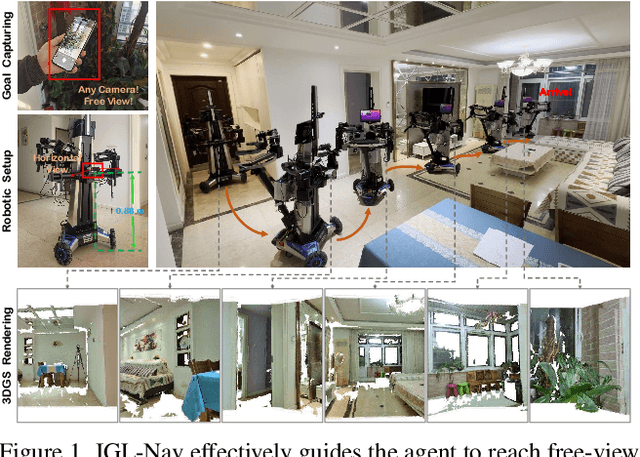
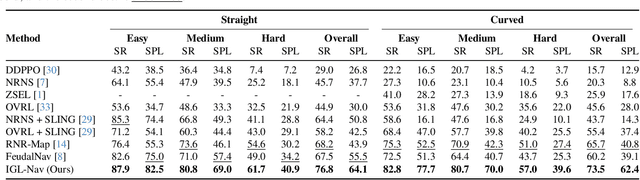
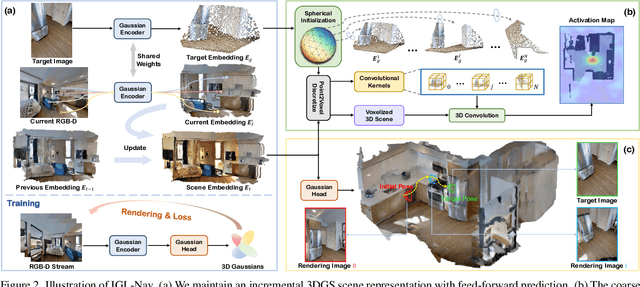
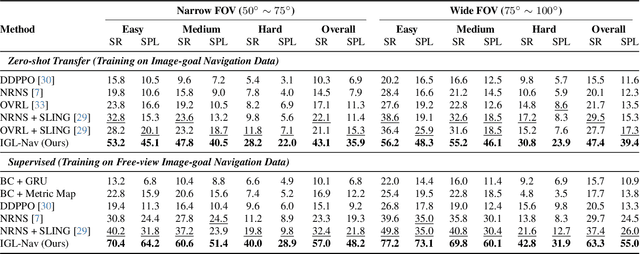
Visual navigation with an image as goal is a fundamental and challenging problem. Conventional methods either rely on end-to-end RL learning or modular-based policy with topological graph or BEV map as memory, which cannot fully model the geometric relationship between the explored 3D environment and the goal image. In order to efficiently and accurately localize the goal image in 3D space, we build our navigation system upon the renderable 3D gaussian (3DGS) representation. However, due to the computational intensity of 3DGS optimization and the large search space of 6-DoF camera pose, directly leveraging 3DGS for image localization during agent exploration process is prohibitively inefficient. To this end, we propose IGL-Nav, an Incremental 3D Gaussian Localization framework for efficient and 3D-aware image-goal navigation. Specifically, we incrementally update the scene representation as new images arrive with feed-forward monocular prediction. Then we coarsely localize the goal by leveraging the geometric information for discrete space matching, which can be equivalent to efficient 3D convolution. When the agent is close to the goal, we finally solve the fine target pose with optimization via differentiable rendering. The proposed IGL-Nav outperforms existing state-of-the-art methods by a large margin across diverse experimental configurations. It can also handle the more challenging free-view image-goal setting and be deployed on real-world robotic platform using a cellphone to capture goal image at arbitrary pose. Project page: https://gwxuan.github.io/IGL-Nav/.
Air Quality Prediction with A Meteorology-Guided Modality-Decoupled Spatio-Temporal Network
Apr 14, 2025Air quality prediction plays a crucial role in public health and environmental protection. Accurate air quality prediction is a complex multivariate spatiotemporal problem, that involves interactions across temporal patterns, pollutant correlations, spatial station dependencies, and particularly meteorological influences that govern pollutant dispersion and chemical transformations. Existing works underestimate the critical role of atmospheric conditions in air quality prediction and neglect comprehensive meteorological data utilization, thereby impairing the modeling of dynamic interdependencies between air quality and meteorological data. To overcome this, we propose MDSTNet, an encoder-decoder framework that explicitly models air quality observations and atmospheric conditions as distinct modalities, integrating multi-pressure-level meteorological data and weather forecasts to capture atmosphere-pollution dependencies for prediction. Meantime, we construct ChinaAirNet, the first nationwide dataset combining air quality records with multi-pressure-level meteorological observations. Experimental results on ChinaAirNet demonstrate MDSTNet's superiority, substantially reducing 48-hour prediction errors by 17.54\% compared to the state-of-the-art model. The source code and dataset will be available on github.